
 E-Paper







HT Explainers Desk delivers in-depth explainers and analysis on the stories shaping India and the world, from SimplyPut, Hindustan Times’ dedicated explainer section. The desk unpacks the science, policy, geopolitics and market forces behind major news events, breaking down complex developments into clear, accessible reporting for readers who want more than the headline. Explainers draw on the expertise of the journalists covering the story and insight from leading subject experts, translating specialist detail into plain language without losing precision or nuance. Coverage spans national and global news — from health and science breakthroughs to trade, technology, cybersecurity, aviation, energy and public policy — going beyond what happened to explain how it works, why it matters and what to watch next. Written for readers who want context, and not just the headlines, HT Explainers Desk brings together original reporting, data and expert analysis to make sense of the news as it develops. It is part of Hindustan Times, India's leading source for news, in-depth analysis and explanatory journalism since 1924.
The 2018 sandpapergate and swing: Science and rules on ball-tampering
How sandpaper helps a ball reverse swing, what fielders may do to a ball, and how tampering has been punished since 2018.


Cameron Bancroft, the Australia opener caught on camera with sandpaper in 2018, said this week the team's fast bowlers knew what he was doing at Cape Town, and they were the ones who stood to gain because a ball rough on one side and polished on the other can be made to curve late in the air, opposite to an ordinary swing.
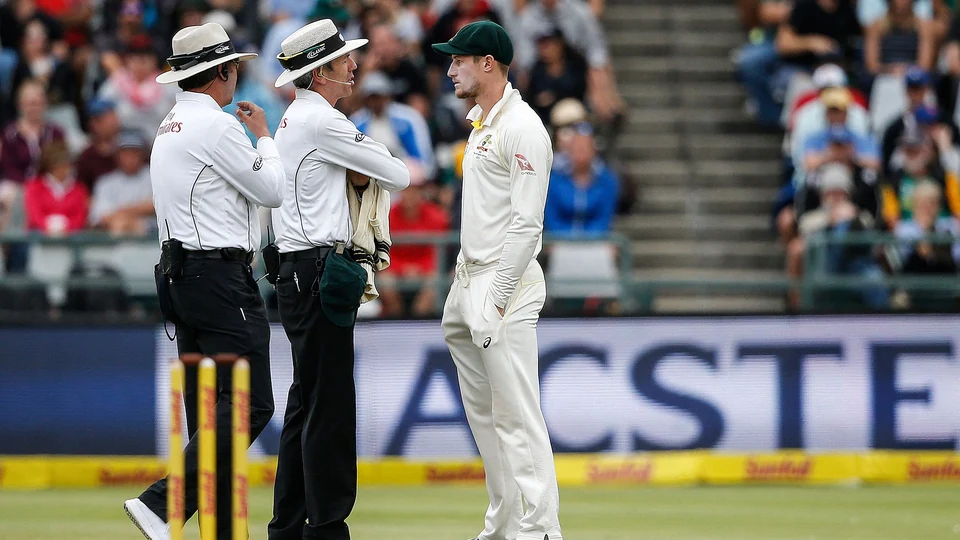
Bancroft made the claim on Wednesday in a column for The West Australian, and said the bowlers told him whether it was working. Cricket Australia (CA) found in 2018 that only Bancroft, then-captain Steve Smith and vice-captain David Warner had known of the plan in advance. It had banned Smith and Warner for 12 months and Bancroft for nine. In 2021, the four bowlers in that Test against South Africa – Pat Cummins, Mitchell Starc, Josh Hazlewood and Nathan Lyon – said in a joint statement that they learned of the sandpaper only when the television footage was shown on the big screen.
The row returned this month with the release of Sabr, the autobiography of Usman Khawaja, the former Australia opener who retired from international cricket this year. "It was all of us. Not the batters, not the bowlers, not the staff. All of us," Khawaja wrote.
Cummins, now Australia's Test and ODI captain, rejected Khawaja’s claim on November 13, saying: "When he says we all knew, if by that he means we knew sandpaper was going out on the field, he's 100 percent wrong." CA has ruled out reopening its investigation but has set up a forum for players and staff to give their accounts, with no new sanctions. Bancroft has said he will attend the forum.
Also read: Truth tampering? Bancroft media statement leaves Aussie cricket reeling
Conventional swing
A cricket ball swings when its path curves in the air after the bowler releases it and before it bounces. Fast bowlers deliver at roughly 97kmph to 160kmph, and a batter in professional cricket has less than half a second to react, according to a 2024 review of 70 years of research on swing, published in the journal Flow.
A new ball has a shiny, lacquered surface and an intact seam, the raised ridge of stitching around its middle. The review says that when the ball is bowled, a thin layer of air called the boundary layer flows over its surface. On the smooth side, this layer stays smooth and breaks away from the ball early. On the side the seam points towards, the seam stirs the air into turbulence. On this side, the air clings to the ball for longer, and the wake behind the ball ends up lopsided, pushing it towards the seam side. This is conventional swing.
Reverse swing, and sandpaper
At high enough speed, the air over the smooth side of the ball can turn turbulent as well, and the push on the ball can flip. The ball, in this case, curves away from the seam, towards its shiny side, and the curve comes late in its flight.
For a new ball, this switch comes at about 137kmph, the review found. A worn ball switches at speeds well below that.
On a new ball, reverse swing is weak. In laboratory tests described in the review, roughening the seam side of the ball increased the reverse-swing force three- to six-fold. Roughening both sides wiped out most of the gain. To get reverse swing, a fielding side needs one side of the ball rough and the other polished.
Bowlers can rough up a ball legally, but it takes several overs. "Whether you're throwing it in the dirt (or) a wicketkeeper is turning it in his gloves to get the one side roughed up," Dale Steyn, the former South Africa fast bowler, told Reuters this month.
Bowlers can also deliver it cross-seam, with the seam held sideways, so the ball hits the pitch on its leather, for six to 10 overs, he said, and then shine one side as hard as they can.
Rubbing the ball with sandpaper roughens the leather at once.
Wasim Akram, the former Pakistan captain and fast bowler, said on November 14 that a bowler would notice. "As an experienced bowler, when I look at the ball, I will know straightaway something is not right," he said, adding that "the sandpaper scratch is totally different than the one-bounce scratch". He said he was not taking any side.
The rules
Under the International Cricket Council's (ICC's) playing conditions for Tests, it is an offence for any player to change the condition of the ball. Fielders may polish it on their clothing, provided they don't use any artificial substance and don't waste time, remove mud under an umpire's supervision, and dry a wet ball on a cloth the umpires have approved.
Since 2022, the Laws of Cricket, written by the Marylebone Cricket Club (MCC), have specified sweat as the only natural substance a fielder may use to polish the ball. Saliva was banned in 2020 as a Covid-19 measure, and the MCC found that the ban had "little or no impact on the amount of swing the bowlers were getting". The ICC made the ban permanent from October 1, 2022.
If the umpires find that a fielder has changed the ball's condition and can say who did it, the batting side gets 5 penalty runs and the batter at the wicket picks a replacement from six balls of varying wear, including a new one. If they cannot identify who did it, the captain gets a first and final warning.
In July 2018, the ICC raised ball tampering from a Level 2 to a Level 3 offence, which now carries a ban of up to six Tests or 12 one-day internationals (ODIs). Under the old rules, the ICC had banned Smith for one Test over Cape Town and fined Bancroft.
Also read: Pat Cummins to remain captain, Cricket Australia show unanimous support amid sandpapergate row
Since 2018
Reverse swing is fading from Test cricket, and fast bowlers and coaches say the fear of punishment after 2018 explained only part of the decline.
Justin Langer, the former Australia opener who took over as coach when Darren Lehmann stepped down, has argued that the scandal nearly killed reverse swing by scaring players away from working on the ball. "I think players are now too scared to even want to touch the ball," Steyn told Reuters.
TA Sekar, a former India player who coaches fast bowlers at the MRF Pace Foundation in Chennai and shaped the careers of Javagal Srinath and Zaheer Khan, disagreed. "There are many reasons why overall the ball is swinging less these days – not just reverse swing. And it takes more than just a strip of sandpaper to generate reverse swing," he told Reuters.
He pointed to Tests that end within three days, before the ball gets old and rough, and to the spread of wobble-seam bowling, in which the seam is released wobbling so the ball can move either way off the pitch. Reuters also cited better-kept outfields, which make it harder to rough up one side legally, and the saliva ban.
Cummins, speaking on November 13, said reverse swing depends largely on conditions. "Even in Australia, the (Sydney Cricket Ground) might reverse, the square is normally quite abrasive, but an Adelaide Oval won't, because it's always beautifully presented," he said.





