
 E-Paper






Utkarsh Anand is the National Legal Editor at Hindustan Times, where he leads the newspaper's coverage of the Supreme Court, constitutional law, the judiciary and the Union law ministry. He joined Hindustan Times in 2020 after stints at Press Trust of India (PTI), The Indian Express and CNN-News18, and has over two decades of experience reporting on law, governance and public policy. His work has focussed on some of India's most consequential constitutional and legal developments, including the Supreme Court's judgments on Article 370, marriage equality, decriminalisation of homosexuality, the Babri Masjid dispute, electoral reforms and judicial appointments. He specialises in making complex legal proceedings and judgments accessible to readers while examining their wider social and political impact. Beyond daily reportage, Utkarsh has led investigative projects and enterprise reporting that have shaped public debate and prompted institutional responses. His work has received several journalism awards, including the Ramnath Goenka Excellence in Journalism Award. As National Legal Editor, he has also played a key role in expanding Hindustan Times' legal journalism footprint, mentoring reporters and strengthening coverage across platforms. A Chevening South Asia Journalism Programme Fellow, Utkarsh regularly writes analyses on the judiciary and constitutional issues, and his reporting is widely followed by lawyers, judges, policymakers, academics and readers seeking clarity on India's evolving legal landscape.
What India’s Constitution would say, if it could speak
The Constitution may emphasise that it was designed “for the people”. That is perhaps a message worth hearing


If the Constitution of India could speak, this would probably be the week it would be allowed to say a few things without being interrupted. For the rest of the year, everyone else speaks on its behalf. Politicians quote it to defend their positions, governments quote it to justify their actions, lawyers quote it to challenge authority, and judges interpret its meaning.
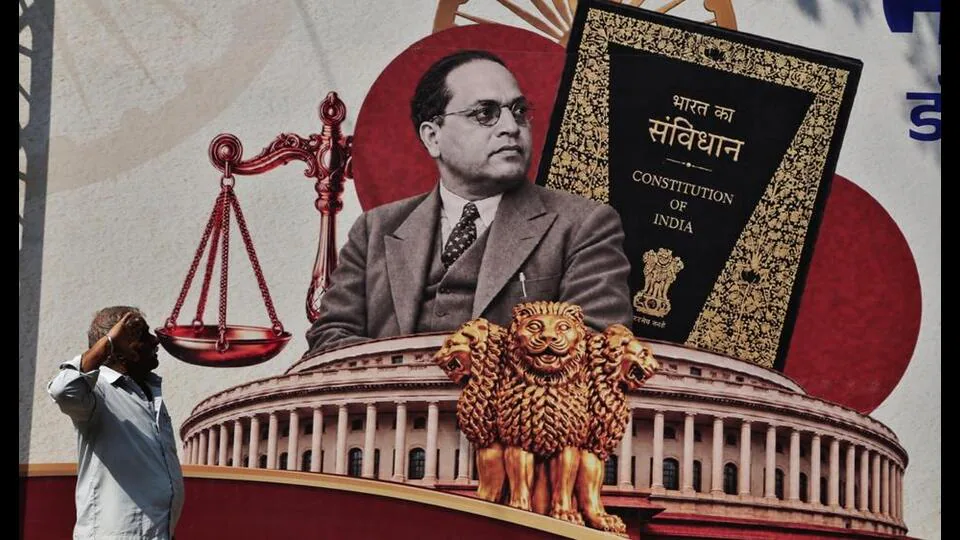
So, in a week when its 77th anniversary fell on November 26, perhaps it deserves a get a few words in.
If it were to speak to the institutions it created, it would not necessarily start with a lecture on the Preamble or a recital of the fundamental rights. It might pose a few direct questions. Some would be congratulatory, but not all of them would be pleasant; and some might even be a little embarrassing. That is what a Constitution is for: To remind us what the Republic truly stands for.
Dear Parliament, a mandate is a responsibility
Let us begin with Parliament, which would probably be the first to get a long letter. “You were given the power to make laws, but not the right to treat legislative disagreement as an inconvenience,” the Constitution might well tell governments that have ruled for the last 77 years, even as it might appreciate their efforts in strengthening constitutional democracy through the decades.
A parliamentary majority is fundamental to representative democracy. It is what enables governments to go implement their plans and give effect to the aspirations of the electorate. However, it is not a carte blanche. The Constitution provides for a Parliament in which there is debate, there are questions, there is scrutiny, and there is an opportunity to hold the governments of the day to account.
Our Oppositions could well be asked some uncomfortable questions, too. Disruption and walkouts may at times be a form of political protest but they cannot become the primary method of engagement in Parliament. If you simply abandon or keep disrupting the debate, you are effectively vacating the very arena in which you are meant to be challenging the government, highlighting its failings, lending a hand in strengthening reforms, and influencing legislation.
The Constitution might also remind Parliament that passing a law and making good law are not necessarily the same thing. Numbers can secure a legislative outcome, but they cannot, by themselves, establish the wisdom, fairness or constitutionality of a decision.
It might remind both sides that accountability is not an act of hostility. Answering questions, explaining positions and accepting criticism are not signs of weakness. They are part of the responsibility of being public representatives.
Dear judiciary, the guardian also lives under the Constitution
The judiciary may be next, and the Constitution could well start with a note of thanks. It is the institution ultimately responsible for interpreting the Constitution, protecting fundamental rights, and ensuring that no branch of government goes beyond the bounds set by the Constitution.
But the compliments might not last very long. “Being the guardian of the Constitution does not mean you are exempt from its discipline,” it might say.
Judicial independence is fundamental to the constitutional scheme. Judges must be free to decide cases without fear or favour, and their authority cannot rest on the fact that the government or the parties to the case like their decisions. That said, independence and accountability are not mutually exclusive. Public confidence in the judiciary is not simply derived from the authority of the judgments; it is also derived from the fairness, transparency and integrity of the institution as a whole.
The Constitution could ask if the justice delivery system is sufficiently aware of the ordinary litigant who has to wait years for a hearing, who may have spent all their money in the process, and who may find that a favourable judgment is only the beginning of a further battle to get that judgment implemented.
It may also serve to remind the judges that a judgment which answers a significant question of law is of value. A justice system which delivers relief in a timely manner is equally so.
The Constitution might then turn to the legal fraternity: “Counsel, you have spent years learning to interpret my words. Please, remember that the person sitting across the table from you may simply be waiting for justice.”
Lawyers are key to the administration of justice. Their contribution cannot be measured simply by the number of cases they have won. Access to justice is more about affordability, professional integrity, and ensuring that the process of going to court does not become a weapon to exhaust those who cannot afford long legal battles.
Dear institutions and citizens, the Republic is not a spectator sport
The Constitution could then have a word with the investigative agencies, universities, regulatory bodies, election commissions, and every other public institution that exercises authority under the law. “I did not create you to occupy offices. I created you to perform functions, and I expect you to do so with independence, fairness and responsibility,” it might say.
Institutions do not just become independent because the law says they are. Their credibility is earned through their decisions, their behaviour and their willingness to act without fear or favour. An institution which is comfortable in the exercise of power but utterly uncomfortable in the face of questions is in danger of destroying the public trust which is the very foundation of its authority.
And then of course, the most difficult of all – a conversation with the people: “Dear citizens, you seem to remember me quite often when someone you oppose is in power. I would appreciate it if you remembered me with the same enthusiasm when your preferred party is in government.”
The Constitution does not belong to one party, one ideology, one community, or one generation. You cannot claim the protection of the Constitution only when it suits you. The freedom of expression, which we claim for ourselves, must be claimed for others as well.
The Preamble’s commitment to fraternity is particularly pertinent in this context. It is one thing to talk about fraternity in a formal setting while it is quite another to actually live it when political, religious, linguistic and social differences have become the basis of suspicion and antagonism. A constitutional democracy cannot survive on liberty and equality alone if the capacity of citizens to see one another as equal members of the same Republic has been eroded. The Constitution might finally ask everyone to stop treating it as a document that can be summoned only when convenient.
Seventy-six years after its adoption, the Constitution has survived changes of governments, political upheavals, institutional confrontations and an extraordinary transformation of Indian society. Its resilience is a tribute to the foresight of the Constituent Assembly, but its future cannot be secured by the document alone.
Perhaps, if the Constitution could speak on its 77th anniversary, it would not ask for another grand celebration. It might simply ask Parliament to debate a little more, governments to explain a little better, Oppositions to be a little more constructive, courts to deliver justice a little faster, institutions to act a little more independently and citizens to show a little more tolerance towards one another. None of these would be unreasonable demands. They are, after all, part of the constitutional bargain.
And in closing, the Constitution may emphasise that it was designed “for the people”. That is perhaps a message worth hearing, not just on November 26, but on every other day of the year.
The views expressed are personal





