
 E-Paper




 Trending News
Does Nvidia Really Need Its Brilliant Nutjob?
President Trump brought back Jensen Huang before investors could fully assess his value to the company.




President Trump clearly thought he was saving the artificial intelligence trade when he dialed into Nvidia’s board meeting last weekend to instruct the directors to hire back ousted chief executive Jensen Huang. He may have done the opposite.
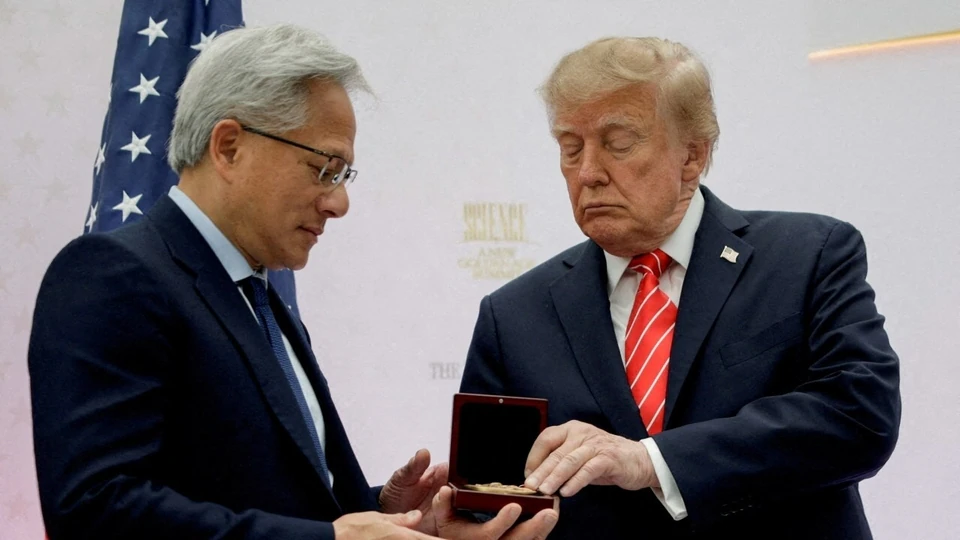
Understand at the outset that the following argument is independent of whatever has happened to Nvidia’s share price, or any other artificial-intelligence company’s, in the days since Mr. Huang resigned. One of Mr. Trump’s analytical errors here appears to have been an extreme reactivity to one-day market swings. The rest of us can avoid that mistake.
Look instead at the problems investors are trying to solve on an ongoing basis regarding AI companies in general and Nvidia in particular. In no specific order: What’s the best relationship between the company and the government? (And which government—America’s or China’s?) When should one push back on politicians who would limit your business with export controls, say, and when should you go along to get along?
How should the AI build-out be financed? Is it sustainable for a profitable company such as Nvidia to act as a bank to its potential customers until they get up and running? What “moats” are available, whether innovation or commercial arrangements, to protect against well-financed competitors?
And looming over it all is the age-old challenge of how to manage an innovative founder. The skill set that makes you a genius inventor and fearless entrepreneur also makes you an absolute nightmare for a corporate board, a chief financial officer and, yes, a human resources department. ChatGPT informs me that the academic literature describes this phenomenon as “entrepreneurial non-normativity,” “rogue entrepreneurship,” or “idiosyncratic vision.” Being a simple journalist, I prefer to call them brilliant nutjobs.
Nothing is new about this, but each generation seems to experience it in a modulated way. An emerging challenge for AI is the particular need for spokesmen to explain and defend the technology and reassure the public about its safety, while managing fraught relations with the political class and navigating global geopolitical tensions around access to models and computing capacity. The open question is whether all of this is helped or hurt by enforcing a more recognizable form of corporate governance at AI companies.
Mr. Trump, perhaps inevitably, has defaulted to the great-man theory of management. The rationale for foisting Mr. Huang back onto an unwilling company is that AI, in its current stage of development, needs the brilliant nutjobs in situ. Maybe, but it’s far from obvious that this is true across the AI industry, or at Nvidia.
It may be the case that Mr. Huang holds in his head countless brilliant ideas for future chip development, as Mr. Trump suggested this week, and that if not hired back by Nvidia the executive might cart his expertise off to China, as Mr. Trump says he feared. Mr. Huang also demonstrates unflinching faith in Nvidia’s financial model—turning itself into what’s been described as the central bank of AI via its circular funding of its customers—despite apparent concerns among other managers. This may be essential in some way to propping up AI valuations.
But against all that one has to weigh the hard-to-assess cost to Nvidia of having a chief executive the U.S. national-security apparatus now finds difficult to trust owing to his romantic escapades with a woman accused of connections to Beijing’s intelligence service. Easier to quantify over time will be the costs associated with a chief executive who appears to be a walking litigation risk, several times over. They’re likely to be large.
To crystallize the question: Is whatever innovation Mr. Huang brings to the table sufficiently valuable to Nvidia and its shareholders that it justifies the sacrifice of earnings to manage his legal problems? And can the company realize the full earnings potential of his inventiveness if he’s likely to find himself crosswise of many parts of the U.S. government that aren’t Donald J. Trump?
Again, none of the answers here are obvious. Whether the “brilliant” outweighs the “nutjob” or vice versa is a decision best made on a case-by-case basis. Investors were in the process of figuring it out before Mr. Trump inserted himself. One shouldn’t assume that one or more truly awful days for the share price are dispositive.
That is exactly how Mr. Trump has made himself such a menace to Nvidia and the business of AI as a whole. One can assume that eventually AI will reach the point, hit by every previous industry, where its executives no longer are household names. Short-circuiting Mr. Huang’s firing-in-all-but-name also has short-circuited a crucial early attempt to regularize the management at a large AI company. It is an experiment we would have been better off allowing to run.





