
 E-Paper






The Hindustan Times US Desk brings you the latest news and developments from across the United States. The team covers everything from breaking news and politics to sports, business, entertainment and stories that are trending across the country. Our coverage includes the White House, Congress, US elections, immigration and visa updates, H-1B, green cards, Social Security, education, jobs, layoffs, the economy, technology and major policy changes. We also closely follow stories that matter to Indian and South Asian communities in the US. The desk covers major US sports, including the NFL, NBA, MLB and NHL, along with player news, injuries, schedules, results and major events. Entertainment coverage includes Hollywood, celebrities, television, streaming, music and pop culture. We also report on breaking developments, major incidents, weather, public safety, court cases and other stories making headlines across the country. When a major policy or news development affects people's everyday lives, the team works to explain what happened, what it means and what readers need to know. Alongside breaking news, the US Desk produces explainers and practical stories on topics such as immigration, Social Security, taxes, education, employment and government programmes. The team also works on science, tech, business and AI stories analyzing the impact they may have on people. The team follows developments throughout the day, keeping an eye on official announcements, public records, reliable news sources and what people are talking about across the US.
 Trending News
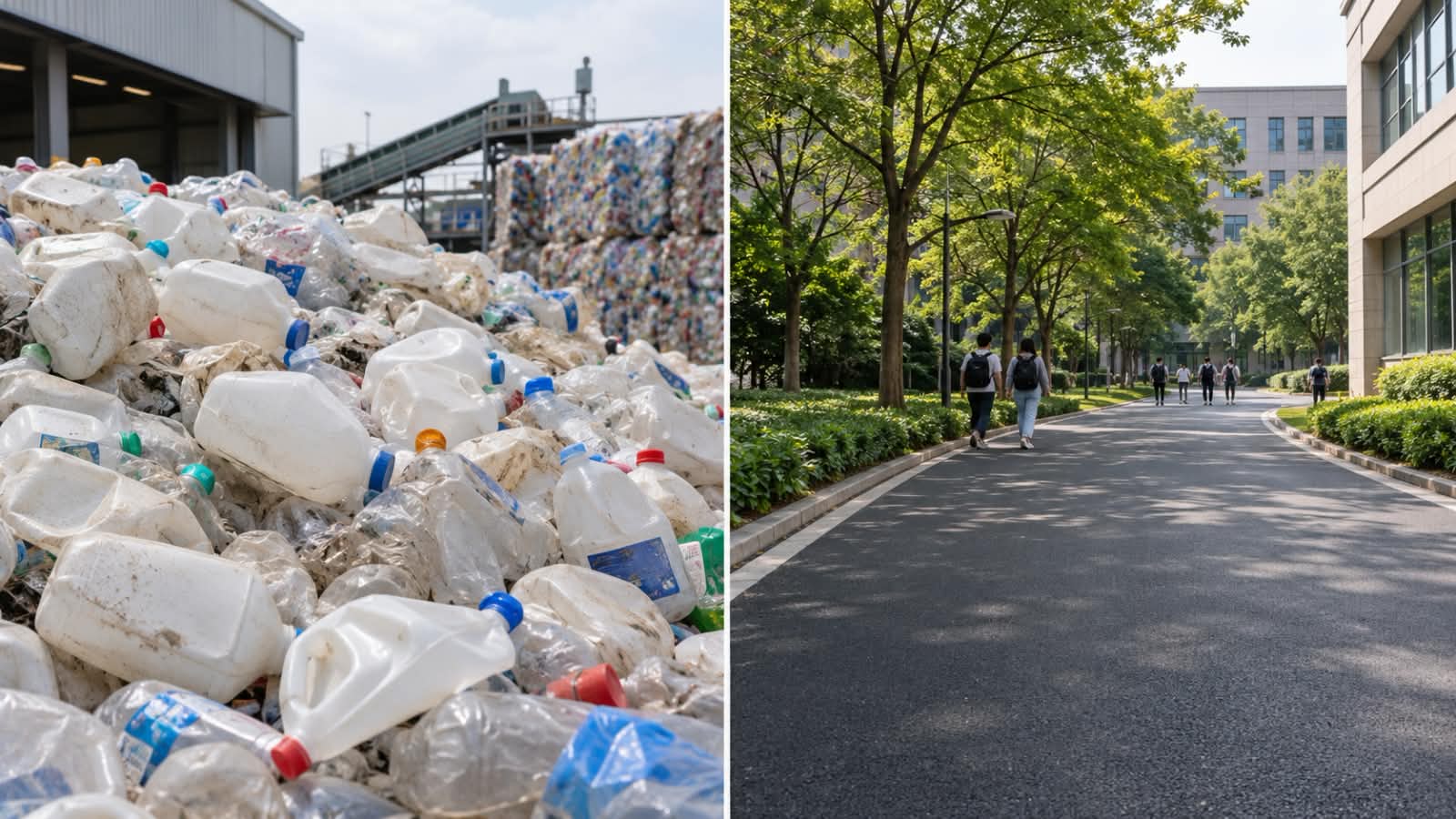
Shanghai’s 300-meter “Milk Bottle Road” incorporated plastic from over 6,000 used milk bottles, putting discarded packaging into a campus road surface
Shanghai’s recycled plastic road turns waste milk bottles into asphalt, but more research is needed to prove its long-term sustainability.


What if you realized that your previous plastic container of oat milk was suddenly used for the pavement beneath your feet? While this may sound like fiction, it is, in fact, a 300-meter section of road in Shanghai. So can we literally road our way out of the plastic issue, or is it merely an image-boosting exercise? Dow and Dairy business Shiny Meadow issued a press release, working alongside East China University of Science and Technology, to produce China's first plastic road, unveiled on Apr 22, 2021. Over 6,000 used milk bottles were shredded, melted, and then combined with the asphalt to create a road surface. Unwanted plastics have therefore been transformed, with the aid of Dow’s ELVALOY RET asphalt additive, into a daily surface that thousands of students both walk and cycle along.
The problem hiding in the recycling bin
In theory, milk bottles can be recycled, but in practice, they frequently are not. Again, according to Dow, milk left in bottles can compromise the quality of the plastic, and many recycling centers are not sufficiently resourced to manage this effectively. Consequently, even plastics that could be reused are commonly disposed of in landfills or by burning. This project did not develop new recycling systems, but attempted to address this issue by diverting “unrecyclable plastics” into road construction.
Dow’s asphalt additive was used in this process. Although this is an innovative solution, there is also a degree of mutual benefit at play. Dow profits from selling the asphalt additive, and Shiny Meadow benefits from telling an eco-friendly story. Although this does not invalidate the science, it serves as a good illustration of how press releases, typically, are primarily for promotional purposes.
It's not just a Shanghai thing
Plastic roads are in fact becoming a genuine area for engineering innovation. And the U.S. is similarly involved. A 2025 Virginia Transportation Research Council report titled “Evaluation of Recycled Plastic Modified Asphalt Mixtures and Pavements: Phase I - A Case Study in Virginia,” commissioned by the Virginia Department of Transportation and the Federal Highway Administration, found that asphalt composites containing recycled plastics functioned comparably, and in some cases more effectively than regular asphalt in withstanding shearing and cracking. This is an important finding as, once again, it shows that in addition to being a university experiment, such roads are also currently undergoing real-world trials by state transportation departments.
The catch people often miss out
If plastics are ground up and then vehicles are driven along a road surface containing them, what happens to the microplastics? A group led by Penn State University researchers investigated this and found that plastic-amended asphalt was, in fact, more robust than regular asphalt and emitted fewer microplastics overall in laboratory conditions when exposed to simulated environmental factors, including traffic and water. This is documented in the Oct 2026 study titled “Microplastics release from recycled plastic modified asphalt: Detection, characterization, and environmental implications,” published in the Journal of Cleaner Production.
This is all very positive. However, the researchers emphasized that their investigation only analyzed one type of asphalt and one form of plastic. Further research is required to examine how actual roads, exposed for many years to the effects of sunlight, precipitation, and vehicle contact, behave. The Virginia report also noted uncertainty over how much microplastic is released into the environment through long-term road deterioration. Clearly, then, those carrying out the research are more restrained in their conclusions than is often the case with media stories surrounding “Milk Bottle Roads.”
So, should we be encouraged?
To an extent, yes. Nevertheless, a 300m road is by no means a solution to the approximately 36 million tons of plastic waste produced every year in the U.S. alone. Likewise, one Shanghai pavement is by no means a replacement for improved recycling systems. Nonetheless, as a pilot scheme, it demonstrates a valuable method of repurposing “unrecyclable” plastics into an essential structure, instead of sending them to landfills or incinerators. For today’s millennial and Gen Z generations, sceptical of corporate greenwashing, the important message is not that the issue has been resolved. Rather, it is that an encouraging yet still experimental solution is being explored, and, pleasingly, this is also the message that scientists are conveying.





