
 E-Paper






The Hindustan Times US Desk brings you the latest news and developments from across the United States. The team covers everything from breaking news and politics to sports, business, entertainment and stories that are trending across the country. Our coverage includes the White House, Congress, US elections, immigration and visa updates, H-1B, green cards, Social Security, education, jobs, layoffs, the economy, technology and major policy changes. We also closely follow stories that matter to Indian and South Asian communities in the US. The desk covers major US sports, including the NFL, NBA, MLB and NHL, along with player news, injuries, schedules, results and major events. Entertainment coverage includes Hollywood, celebrities, television, streaming, music and pop culture. We also report on breaking developments, major incidents, weather, public safety, court cases and other stories making headlines across the country. When a major policy or news development affects people's everyday lives, the team works to explain what happened, what it means and what readers need to know. Alongside breaking news, the US Desk produces explainers and practical stories on topics such as immigration, Social Security, taxes, education, employment and government programmes. The team also works on science, tech, business and AI stories analyzing the impact they may have on people. The team follows developments throughout the day, keeping an eye on official announcements, public records, reliable news sources and what people are talking about across the US.
 Trending News
Yonkers uncovered a river buried beneath a parking lot; within six months, the restored stretch supported nearly 14,000 sq ft of aquatic habitat
After nearly 90 years beneath a parking lot, Yonkers daylighted the Saw Mill River, restoring 13,775 sq ft of aquatic habitat downtown.


After being concealed underneath a parking lot in downtown Yonkers, New York, for close to 90 years, a river has finally been given a new lease on life, creating a home for fish and other creatures. The restoration of the Saw Mill River brought a portion of downtown back to life as an open water feature. In six months since the river's unveiling, 13,775 square feet of aquatic habitat has been created.

The project demonstrates the potential of urban river restoration, an approach that research published in Ecological Engineering has associated with changes in aquatic habitats and the return of invertebrate communities. This includes changes in aquatic habitats and the return of vertebrate communities. The daylighting effort exposed a section of the river that had been piped as the city grew and was part of an effort to revitalize downtown Yonkers by converting an asphalt town square into a park and water feature.
A river disappears beneath the growing city
The Saw Mill River was an integral part of Yonkers' history. From as early as the 1650s, the flowing water of the river was harnessed to run grist mills. This set the foundation for the community's transition to a center of industry. As the urban area grew, space demands meant that the river was gradually confined, and the last remaining section through the downtown was covered over in the 1920s. A parking area was created on top and was called Larkin Plaza. The river continued flowing underneath in a separate channel out of sight and out of mind.
Daylighting was officially endorsed in 1992 when the U.S. Army Corps of Engineers deemed the daylighting of the buried section to be an achievable restoration project. A significant development occurred in 2001 with the establishment of the Saw Mill River Coalition under Groundwork Hudson Valley, an organization uniting local business and governmental support for the plan. After years of planning, securing funding, and public consultation, construction started in 2010.
Six months later, the restored stretch supported aquatic life
There were multiple engineering problems associated with removing the parking and daylighting the river. The area was an old industrial site with contaminated earth. To reopen the original subterranean channel, the engineers designed a new temporary above-ground channel to be used for the duration of construction. A barrier was installed to protect the new above-ground channel from the contaminated earth, and the existing concrete channel was kept as a secondary channel for high water flow.
Water began flowing through the restored section in November 2011. By April 2012, the area had developed into an active aquatic environment. According to Groundwork Hudson Valley, the project recreated 13,775 square feet of aquatic habitat comprising one tidal pool and two freshwater pools. The restored waterway supported turtles, ducks, blue crabs, black-nosed dace, and American eels.
Native plants were also introduced along the banks, helping establish riparian habitat and attracting insects that contribute to aquatic food webs. A 2021 study published in Restoration Ecology examined a daylighted urban stream in Oslo, Norway. Within nine months, researchers found aquatic algae and small invertebrates that had started colonizing the daylighted reach. These results suggested that reopening buried streams and rivers can facilitate the return of aquatic biota through the success of such projects.
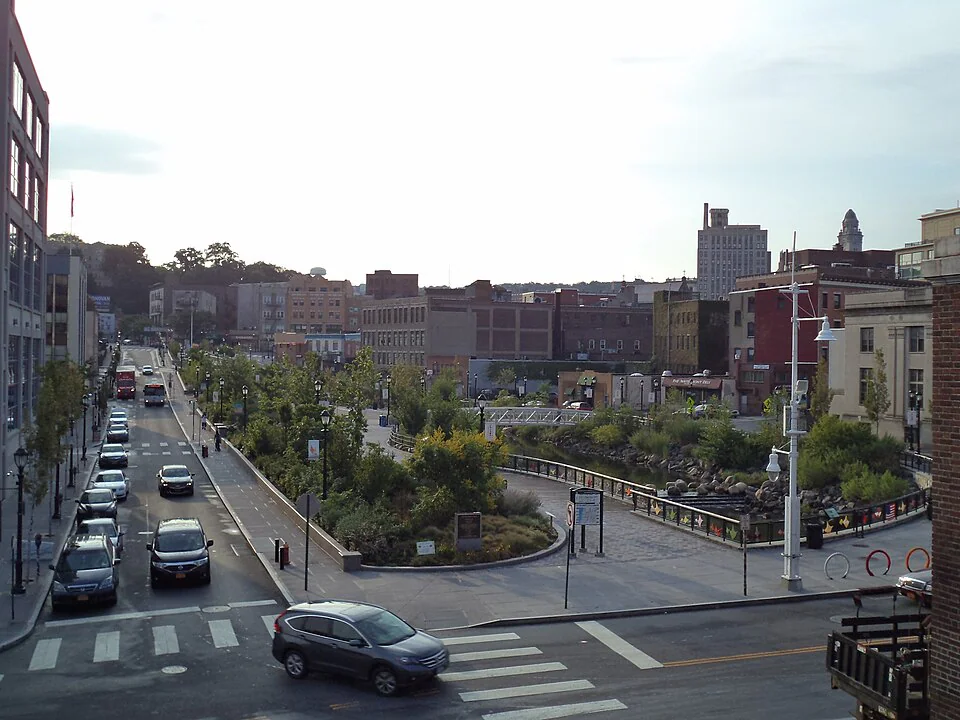
From parking lot to public green space
The river that was brought to light has become the key feature in Van der Donck Park, which opened in 2012. It combined a daylighted river with park landscapes and interpretive displays about the history and nature of the river. This site was recognized as a National Fish and Wildlife Urban Refuge in 2014. The daylighting did not stop there, with further sections of the river being uncovered at Mill Street Courtyard in 2016 and on New Main Street in 2018, expanding the daylighting beyond Larkin Plaza.
The project also illustrates why restoring urban waterways requires more than removing concrete. A 2020 review published in Water Security examined daylighting and its potential benefits for urban climate adaptation, but found limited research to support these benefits. Potential benefits will be highly project-specific and depend on factors including water quality, land use in the corridor, stormwater and flood management, and stream maintenance. The Yonkers project restored a lost urban river and created new aquatic habitat. The daylighting project demonstrates a shift in how urban rivers are perceived, from a hindrance to development to an environmental and community benefit.





