



 Live Score
 Teams
 Players


Rasesh Mandani loves a straight drive. He has been covering cricket, the governance and business side of sport for close to two decades. He writes and video blogs for HT.
ICC to introduce bat gauges in international cricket
Bats will come under greater scrutiny once umpires are empowered to check if batters are flouting rules.
Updated on: Nov 23, 2026, 16:09:05 IST


Share via
Copy link
We are having more sixes being hit every passing year in T20 cricket. Some of it may be down to batting-friendly pitches. Smaller boundaries may be another reason. But standardisation of pitches is not an exact science, and making room for commercial signage at the boundary ropes is a new reality.
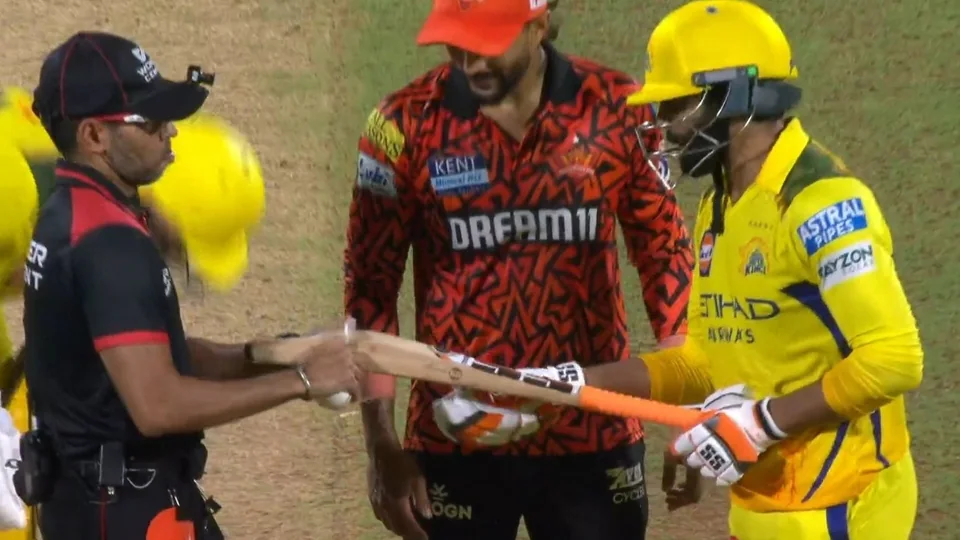
There’s one other way in which the International Cricket Council (ICC) is set to get stricter with the batters who may be out to take undue advantage.
Random size checks of bats is about to become common in international cricket. Match officials will soon ask players to pass their bats through a measuring gauge before entering the crease. The practice was introduced in IPL last year.
Also Read: Does Shubman Gill's captaincy lack a sense of adventure?
This is one of the recommendations of the Sourav Ganguly-chaired ICC cricket committee that received the green light from the Chief Executives Committee during the governing body’s recent meetings in Bali, HT learns.
It will soon be in play, once the umpires have been briefed on the implementation. Currently, Law 5 of the MCC’s Laws of Cricket restricts the thickness of bat edges to 1.56 inches, depth to 2.64 inches and their width to 4.25 inches.
The bat size issue has been heavily scrutinised in the wake of the increasing six count. The game’s most watched league, IPL, has transformed over the years, with 19.27 sixes being hit per match in this year’s edition. Compare that to the inaugural edition in 2008, when only 8.88 sixes per match were struck. A lot of it may be down to the improved power-hitting techniques. But there is fear that equipment misuse may also occur.
It is a given that broader or meatier bats can facilitate explosive hitting to the detriment of the bowlers, widening the bat-ball imbalance. Some believe that the advancement in bat quality has outpaced the development of the ball, leading to calls for the weight, size and dimensions of the blade to be scrutinised like the ball is.
Before IPL decided that bats must pass the gauge test, some match officials suspected that meatier bats were being used. Even when bat checks were done a day before the game, the entire set of bats in a kit bag was not being scrutinised. This left a loophole, allowing players to walk into the match with untested bats. Stricter monitoring was enforced with the hope of ensuring better compliance. The feedback has been positive.
In IPL, players like Sunil Narine, Ravindra Jadeja, and Riyan Parag had to change their bats after they failed to pass through the rectangular gauge carried by umpires. Even if it is due to manufacturing issues, such bats would now be outlawed.
Different balls to be trialled
Work is underway to strengthen the quality of the balls. With this objective, ICC’s cricket committee has recommended the trialling of a different cricket ball, beginning with age-group cricket at the 2029 and 2030 U19 World Cups. It was also decided to introduce a competitive procurement process for new balls while strengthening their approval pathway.
Currently, all major ICC limited-overs tournaments use white Kookaburra balls. For uniformity and match preparedness, national boards too use that ball in bilateral games. Although a competitive marketplace is being encouraged, officials are clear this is not being seen as a look out for alternatives to Kookaburra, but more of a research and development measure.
ABOUT THE AUTHOR

Get live cricket scores, match updates, schedules, results and ICC rankings. Follow the latest news, statistics and performances of top teams, players update on Hindustan Times.





